Choose the best prototype materials for functional testing by matching load, heat, finish, and process to the decisions your team needs to make early.

A prototype can fit perfectly on an
assembly bench and still give the wrong answer. A clear SLA housing may look
production-ready but crack at a screw boss. A soft 3D-printed hinge may survive
a few cycles yet fail when molded in the intended resin. Selecting the best
prototype materials for functional testing starts with the decision
the test must support, not the fastest or lowest-cost process.
For engineering teams,
procurement managers, and OEM product developers, the useful question is not
simply, “What material can make this part?” It is, “What material and process
will reproduce the risk we need to remove before tooling?” That risk may
involve load, temperature, assembly force, repeated movement, sealing,
electrical fit, surface wear, or user handling.
Best Prototype Materials for
Functional Testing Start With the Test
Functional testing should be separated from visual
review. If a prototype is only needed to confirm general shape, hand feel, or
color direction, appearance-focused materials can be appropriate. If it must
carry load, retain threads, withstand a drop, or operate in a thermal
environment, the prototype needs properties close enough to the planned
production part to make the result credible.
Define the test condition
before choosing the material. Record the expected force, number of cycles, operating
temperature, chemical exposure, mating components, and pass or fail criteria. A
prototype that is tested without a defined failure condition often produces
subjective feedback rather than engineering data.
The production material is
usually the best baseline, but it is not always practical at the early stage.
Injection-molded engineering plastics require tooling, while die-cast parts
require dedicated dies. CNC machining, SLS printing, SLA printing, silicone casting, and soft
tooling can each provide a practical intermediate step. The right choice
depends on which production characteristic matters most at that point.
CNC-Machined Plastics for
Mechanical Performance
CNC machining is often the strongest option when
functional tests require predictable material properties, tight tolerances, and
representative assembly behavior. Parts can be machined from production-grade
or near-production-grade stock, including ABS, PC, PC-ABS, POM, nylon, PMMA,
PP, PEEK, and glass-filled engineering plastics where appropriate.
For enclosures, brackets,
latches, clips, fixtures, and mating components, machined plastic can reveal
issues that common photopolymer prints hide. It is particularly useful for
evaluating screw retention, press fits, snap features, structural stiffness,
and tolerance stack-up. A machined polycarbonate component, for example, is a
better basis for impact and assembly assessment than a clear brittle resin that
only resembles polycarbonate visually.
There are limits. Machining
may not reproduce the internal stress, flow direction, weld lines, or shrinkage
behavior of an injection-molded part. It can also be expensive for highly
complex geometry or parts with deep cavities and undercuts. Still, for
low-volume functional builds, it provides a reliable path to
material-representative testing without waiting for production tooling.
When CNC Plastic Is the Better
Choice
Choose CNC-machined plastic when the test depends on dimensional
accuracy, real polymer behavior, threaded inserts, structural load, or contact
with actual production hardware. It is also a practical route when an
engineering team needs a small number of parts for verification before
releasing tooling.
SLS Nylon for Durable Complex Parts
Selective laser sintering is well suited to complex
functional prototypes that need durability without the support structures
associated with many resin printing processes. Nylon 12 is commonly used for
housings, ducts, brackets, clips, and assemblies with internal channels or
complex geometry. Nylon 11 can offer greater flexibility and impact resistance
for certain applications.
SLS nylon is valuable for
early functional testing because it produces parts with useful toughness and
allows multiple design iterations quickly. It can be a good choice for checking
ergonomics, clearances, fit with neighboring components, and moderate-load
performance. For production concepts involving nylon or similarly durable
plastics, it can provide more meaningful test results than standard SLA resin.
However, SLS parts have a
matte, grainy surface and can be porous unless post-processed. Their mechanical
properties can vary by build orientation and wall thickness, and they should
not be assumed to match injection-molded nylon exactly. For sealing surfaces,
cosmetic exterior panels, high-precision interfaces, or thin snap arms with
critical fatigue requirements, CNC machining or molded pilot parts may be more
appropriate.
SLA Resins for Fit, Detail, and
Controlled Validation
SLA prototypes produce fine detail, smooth surfaces,
and accurate small features. They are effective for validating compact
electronic housings, connector geometry, button travel, optical layouts,
display windows, and cosmetic form. Tough, durable, high-temperature, flexible,
and clear resin families broaden the range of possible tests.
The trade-off is that a
resin’s product label does not guarantee equivalence to a production
thermoplastic. Tough resin may be adequate for short-term assembly testing, but
repeated impacts, UV exposure, heat aging, and chemical contact can produce
behavior unlike ABS, PC, or nylon. Resin parts also require attention to
post-curing, wall thickness, and orientation because these factors affect final
strength.
Use SLA when the main question
concerns precision, surface detail, short-run fit, or limited functional
behavior. Do not use a standard visual resin as evidence that a high-cycle snap
fit or load-bearing feature is production-ready. In those cases, the prototype
material should move closer to the intended molded polymer.
Metal Prototypes for Load, Heat,
and Wear
When a component manages high force, elevated
temperature, conductivity, wear, or corrosion exposure, a plastic substitute
can create misleading results. CNC-machined aluminum, stainless steel, brass,
copper, and other metals are appropriate for functional prototypes of frames,
heat sinks, brackets, shafts, threaded components, electrical contacts, and
precision mechanical assemblies.
Aluminum is often selected for
early housings and structural components because it machines efficiently and
supports realistic assembly testing. Stainless steel is better when strength,
corrosion resistance, or wear is central to the requirement. For metal parts
planned for die casting, machining can validate geometry and assembly, but it
will not fully replicate casting-specific issues such as draft, porosity,
wall-thickness limits, and local shrinkage.
A prototype should therefore
answer the right question. Machined aluminum may confirm that a bracket carries
the required load. A later die-cast sample is still needed to confirm that the
same design can be produced consistently at volume.
Silicone and Elastomers for Sealing
and User Interaction
For gaskets, overmolded grips, buttons, valves,
protective covers, and soft-touch components, silicone and elastomer behavior
must be tested as a material system. Hard plastic prototypes cannot accurately
predict compression set, sealing force, tactile response, tear resistance, or
long-term recovery.
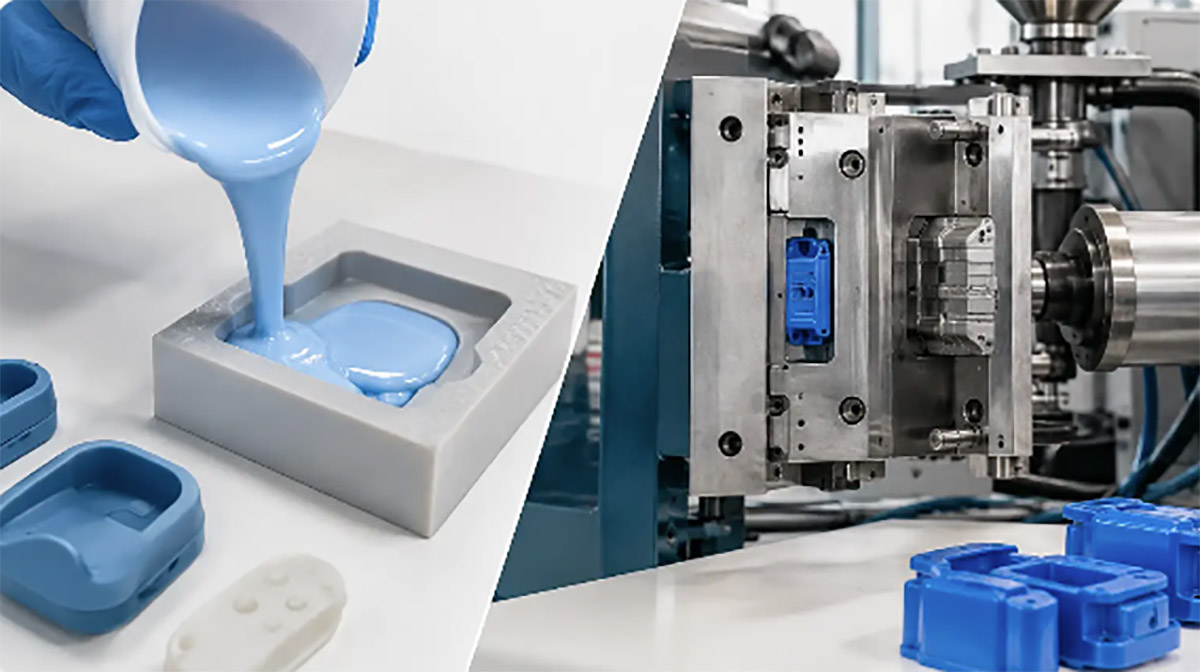
Silicone casting in prototype
molds is useful for producing low-volume parts in a specified Shore hardness.
It allows teams to test fit around mating surfaces, button actuation, gasket
compression, and user handling before committing to production tooling.
Polyurethane cast parts can also serve as a bridge for certain flexible or
rigid prototype needs, depending on the target material and test environment.
Material hardness alone is not
enough. Geometry, wall thickness, gate location, curing conditions, and contact
surface finish all influence performance. A sealing test should use the
intended mating materials and expected clamping force, rather than evaluating
the gasket in isolation.
Use Soft Tooling When Process
Behavior Is the Risk
There is a point where a prototype must stop being
only a part and start being a process trial. Silicone tooling, aluminum
tooling, and low-volume injection molding are useful when the unresolved
question involves molded part behavior: snap fatigue, texture, shrinkage, color
consistency, insert molding, overmolding, or assembly throughput.
Soft tooling costs more than a
printed or machined prototype, but it can prevent a much more expensive
correction after hard tooling is released. It is especially justified when a
product is approaching pilot production, when several components must
assemble together, or when the design includes features that cannot be fairly
evaluated in an additive process.
For many projects, the most
efficient sequence is not one material choice but a staged plan. Early SLA
parts can verify detailed fit. SLS or CNC parts can test functional geometry.
Soft-tool samples can validate molding behavior and pilot assembly. Each stage
should remove a defined category of risk before the next investment.
Avoid False Confidence in
Functional Test Results
A functional prototype is only useful when its
limitations are documented. If a CNC part is machined from a production-grade
resin, note that it does not represent molding shrinkage. If an SLS nylon part
is used for a latch test, record its surface condition and build orientation.
If a silicone-cast gasket is evaluated, confirm the actual hardness and
compression condition.
Teams also benefit from
testing the assembly, not just individual components. A part may pass a bench
load test but fail when tolerances from the enclosure, fasteners, PCB, battery,
and sealing elements accumulate. Building a small pilot assembly often exposes
issues in access, fastener sequence, fixture needs, cable routing, and operator
handling that a single-part review cannot show.
Xiamen Creator Technology
supports this progression across rapid prototypes, CNC machining, additive
manufacturing, tooling, molding, assembly, and production-oriented review.
Coordinating these stages through one manufacturing workflow helps preserve
design intent while making material and process changes easier to track.
The best prototype material is
the one that makes the next production decision less uncertain. Test the
failure mode that matters now, use a process that represents it honestly, and
increase material and process fidelity as the cost of being wrong rises.