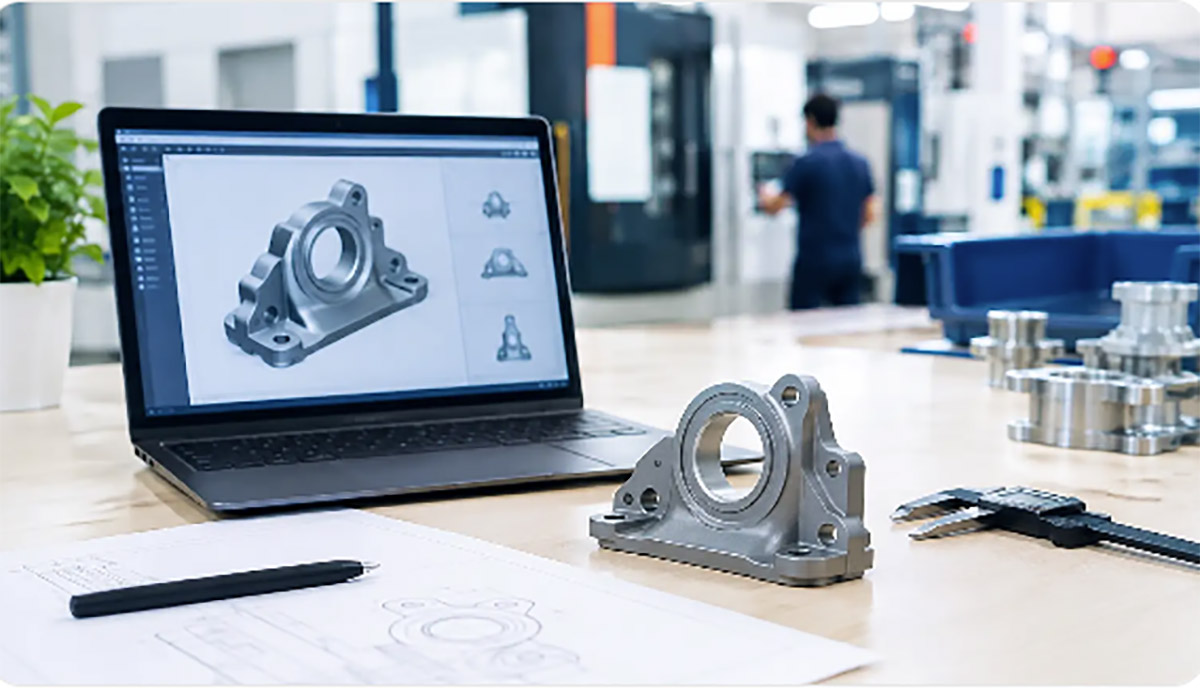
Use this CNC machining supplier review framework to assess capability, quality controls, lead time, cost, and production readiness before placing an order.

A
CNC machining supplier review should begin before the first quote is compared.
A low unit price means little if the supplier cannot hold critical tolerances,
identify drawing risks, provide material traceability, or repeat the same
result when a prototype becomes a production order. For procurement teams and engineers,
the objective is not simply to find machine capacity. It is to select a
supplier that can control the full path from CAD file to accepted parts.
The most useful review process
is practical: evaluate the work the supplier will actually perform, the risks
attached to that work, and the evidence supporting its claims. This helps avoid
a common sourcing problem - a supplier that is suitable for simple one-off
parts but unprepared for repeatable, production-level manufacturing.
Start With the Part Requirements
No supplier can be evaluated accurately without a
clear definition of the part. Before requesting quotations, prepare current 2D
drawings, 3D CAD files, annual volume estimates, material specifications,
surface finish requirements, critical dimensions, inspection expectations, and
any assembly interfaces.
The drawing should identify
which dimensions are functionally critical. A general tolerance block is not
enough when a bore mates with a bearing, a threaded feature receives a
fastener, or a machined face seals against another component. If every
dimension is assigned an unnecessarily tight tolerance, cost rises and
inspection becomes more time-consuming. If critical features are not
identified, the supplier may use an inspection method that does not match the
product's real performance needs.
For early prototypes, some
flexibility may be appropriate. For production components, requirements should
be stable enough to support repeatable fixturing, process planning, and
incoming quality acceptance. A capable supplier will ask questions when
specifications conflict or when a design creates avoidable machining
difficulty.
What a CNC Machining Supplier
Review Should Measure
A useful CNC machining supplier review assesses more
than the number of CNC machines on the shop floor. Capacity matters, but it
should be considered alongside technical fit, process control, communication,
and commercial reliability.
Machine Capability and Part Fit
Ask whether the supplier can machine the required
geometry using the right process. Three-axis milling may be sufficient for
brackets, housings, and flat prismatic components. Complex contours, multiple
angled features, or tight positional relationships may require four-axis or
five-axis machining. Turned shafts, threaded components, and concentric
features may be better suited to CNC turning or mill-turn equipment.
The key question is not
whether a supplier advertises five-axis capability. It is whether the
equipment, workholding, tooling, and programming approach fit your part size,
material, tolerance range, and volume. A five-axis machine does not
automatically produce a better component. For a simple part, it may add
unnecessary cost. For a complex part requiring multiple setups, it can reduce
handling error and improve feature-to-feature accuracy.
Material experience also
deserves direct review. Aluminum, stainless steel, brass, titanium, carbon
steel, POM, nylon, and other engineering plastics behave differently during
machining. A supplier familiar with the specified material is more likely to
choose appropriate cutting parameters, manage deformation, and achieve the
required finish without excessive rework.
DFM Feedback Before Production
A strong supplier reviews
manufacturability before releasing a job to the floor. This design
for manufacturability review should address inaccessible internal corners,
deep narrow pockets, thin walls, difficult-to-machine threads, unrealistic
tolerances, burr-sensitive edges, and surface finish requirements that may
conflict with geometry.
Good DFM feedback is specific.
It should explain the production effect of a feature and offer an alternative
when one exists. For example, increasing an internal corner radius may allow a
larger cutter, reduce cycle time, and improve consistency. Changing a
blind-hole depth or reducing an unnecessarily fine finish may lower cost
without changing the part's function.
Treat this feedback as an
engineering discussion, not a supplier attempt to alter the design for
convenience. Some changes are unacceptable because they affect performance or
brand requirements. Others remove cost and schedule risk before it reaches
production.
Quality Control and Inspection
Evidence
Quality claims should be supported by a defined
inspection process. Review what instruments are available, how often they are
calibrated, which dimensions are inspected, and what records can be supplied
with each lot. Depending on the component, this may include calipers,
micrometers, height gauges, pin gauges, thread gauges, surface roughness
testers, optical measurement systems, or coordinate measuring machines.
For critical parts, clarify
whether the supplier can provide first
article inspection reports, in-process inspection records, final inspection
reports, material certificates, and certificates of conformity. The required
documentation should be agreed before production, not requested after parts
have shipped.
Sampling plans also need
attention. Inspecting a few cosmetic prototype parts is different from
controlling a production lot with functional tolerances. Higher-risk components
may require more frequent checks, dedicated gauges, or 100% inspection of
selected characteristics. The right level depends on failure consequences, lot
size, and the maturity of the process.
Capacity, Lead Time, and Production
Planning
Lead time is more than machining time. It includes
engineering review, material procurement, programming, fixture preparation,
first-part approval, machining, finishing, inspection, packing, and shipping. A
quote that promises a short turnaround should make commercial sense when these
steps are considered.
Ask how the supplier manages
urgent orders, machine downtime, material shortages, and schedule changes. One
small batch can often be expedited. Repeated urgent requests, however, may
disrupt a supplier's planning and introduce avoidable quality risk. A better
long-term arrangement uses realistic forecast information, agreed reorder
points, and clear change-control procedures.
For customers moving from
prototype quantities to recurring production, evaluate whether the supplier can
scale without changing the process unpredictably. A shop that performs well at
20 pieces may need more structured fixturing, inspection planning, and material
management at 2,000 pieces. That transition should be planned, priced, and
validated.
Review Cost Beyond the Piece Price
A CNC quote can vary substantially between suppliers
for valid reasons. Differences may come from material grade, machining
strategy, setup count, scrap allowance, inspection level, finishing source,
packaging, and assumed tolerances. Comparing only unit price can hide these
differences.
Request a quotation that
separates significant cost drivers where practical. Setup and programming
charges are common for prototype orders. Production pricing may improve after
fixtures are amortized and machining cycles are optimized. Surface treatments
such as anodizing, powder coating, passivation, plating, or bead blasting
should be specified clearly because appearance and corrosion requirements
affect both process selection and cost.
The lowest quote can become
the highest landed cost if it results in rejected parts, missed launches,
additional sorting, or repeated engineering clarification. Conversely, premium
inspection documentation may not be justified for a noncritical cover plate. Cost
should match the part's functional and commercial risk.
Test the Supplier With a Controlled
First Order
A first order is the best opportunity to verify how a
supplier performs under real conditions. Begin with a part that represents your
actual requirements rather than an overly simple sample. The order should
include the same material, tolerance expectations, finish, documentation, and
packing needs expected in future business.
Evaluate the experience from
quotation through delivery. Were questions technically relevant? Did the
supplier identify drawing ambiguity? Was the first article submitted on
schedule? Were nonconformities communicated promptly with a corrective action
plan? Did the delivered parts match the approved sample and documentation?
Communication quality is a
production control issue, not merely a service preference. Clear written
confirmation of revisions, tolerances, material substitutions, and inspection
requirements prevents assumptions from moving onto the machine shop floor.
Look for Integrated Manufacturing
Support When Needed
CNC machining is often one part of a larger product
build. A machined aluminum enclosure may require plastic overmolded components,
silicone parts, stamped contacts, die-cast elements, purchased hardware, assembly,
and retail-ready packaging. Managing each process through separate vendors can
work, but it increases coordination points and makes responsibility harder to
trace when schedules or quality problems arise.
For multi-process products,
assess whether the supplier can coordinate tooling, prototyping, component
sourcing, assembly, and final quality control. Xiamen Creator Technology supports this type
of manufacturing workflow, allowing product teams to align prototype
development, CNC parts, tooling, and scaled production under coordinated
project management.
Integrated support is not
automatically the right choice for every program. A specialized machining shop
may be the best fit for an unusually demanding precision component. But when
the product requires several manufacturing processes and controlled handoffs, a
supplier with broader production capability can reduce administrative burden
and shorten the path from approved design to finished goods.
A supplier review is most
valuable when it establishes how work will be controlled after the purchase
order is issued. Choose the partner that can explain its process, document its
results, raise issues early, and produce parts that remain consistent as your
requirements evolve.